Solutions Architecture: what it is, where it acts, and why it creates confusion
Understand what Solutions Architecture really is, where this role fits among other architecture disciplines, and why its scope is still so often misunderstood in practice.
architecture
solutions architecture
software
systems design

Ednaldo Luiz
Level: Intermediate
Level:
Published:
Last updated:
6 min read
views: - views
Introduction
A lot of people treat Solutions Architecture as if it were just another name for drawing boxes and arrows. But that is not the point. The point is deciding how a business need turns into a solution that actually works in the real world, with choices around integration, data, security, performance, availability, cost, and operations.
The diagram shows up as an alignment artifact. It helps different areas see the solution, makes boundaries clearer, exposes critical integrations, and anticipates risks before implementation starts.
This matters because many systems do not struggle because they lack the latest framework or trendy cloud setup. They struggle because they lack direction. Without a well-thought-out solution architecture, teams pile on technology, couple integrations carelessly, and postpone difficult decisions. The bill comes later: rework, rising costs, fragile operations, and a system that becomes harder to evolve.
What Solutions Architecture Is
Solutions Architecture is the work of taking a business need and turning it into a technical response that makes sense within the company’s context.
It defines how functional and non-functional requirements will be met by a viable solution, considering integration, data, security, performance, availability, cost, and operations.
In many cases, that shows up as concrete non-functional requirements, such as:
- response time, for example up to 200ms
- load capacity, such as 50,000 simultaneous requests
- availability, such as 99.95%
- zero downtime during business hours
- elasticity
- operational cost limits
In practice, that conversation becomes decision-making: which capabilities matter most, which systems need to participate, which constraints weigh the most, and, above all, what is actually sustainable in terms of cost, operations, security, and evolution.
For many people, their first contact with this topic comes through the AWS Certified Solutions Architect – Associate (SAA-C03) certification. It gained traction precisely because it reinforces practical pillars of the discipline: security, resilience, performance, and cost.
At the core, the point is simple: Solutions Architecture exists to provide technical direction to a business problem.
The Boundaries of This Role
Solutions Architecture often creates confusion because it touches multiple fronts at once: business, product, engineering, security, and operations. From the outside, it can look like it is trying to own everything. But the real point is its boundary of action.
That confusion does not happen only because many areas are involved in the solution, but also because they do not always speak the same language. In many companies, the same concept gets different names across product, operations, support, sales, or engineering. When that language is not aligned early, the solution starts crooked: the team thinks everyone is discussing the same thing, while each side is actually understanding something different.
To understand what this role does, it helps to start with what it does not do:
- It does not replace Product: the architect does not decide alone what is worth building or which problem has priority for the business.
- It does not replace Software Architecture: it does not, in isolation, dictate every code pattern or the internal structure of a microservice.
- It does not replace security or operations specialists: those areas still own their respective disciplines and deep technical decisions.
The Connector Role
The role of Solutions Architecture is to connect these fronts when the problem requires an end-to-end view. It helps bring coherence to the solution as a whole, making constraints visible and preventing each area from optimizing only its own slice of the problem — which usually leads to a final solution that is expensive, fragile, or hard to evolve.
That need for connection also exists because the organization directly shapes the solution that comes out of it. Teams, internal boundaries, responsibilities, and communication patterns tend to show up in the system design itself. When areas that barely talk to each other need to build something together, that friction tends to reappear in the architecture. Ignoring that usually produces a solution that looks good on paper and misaligned in practice.
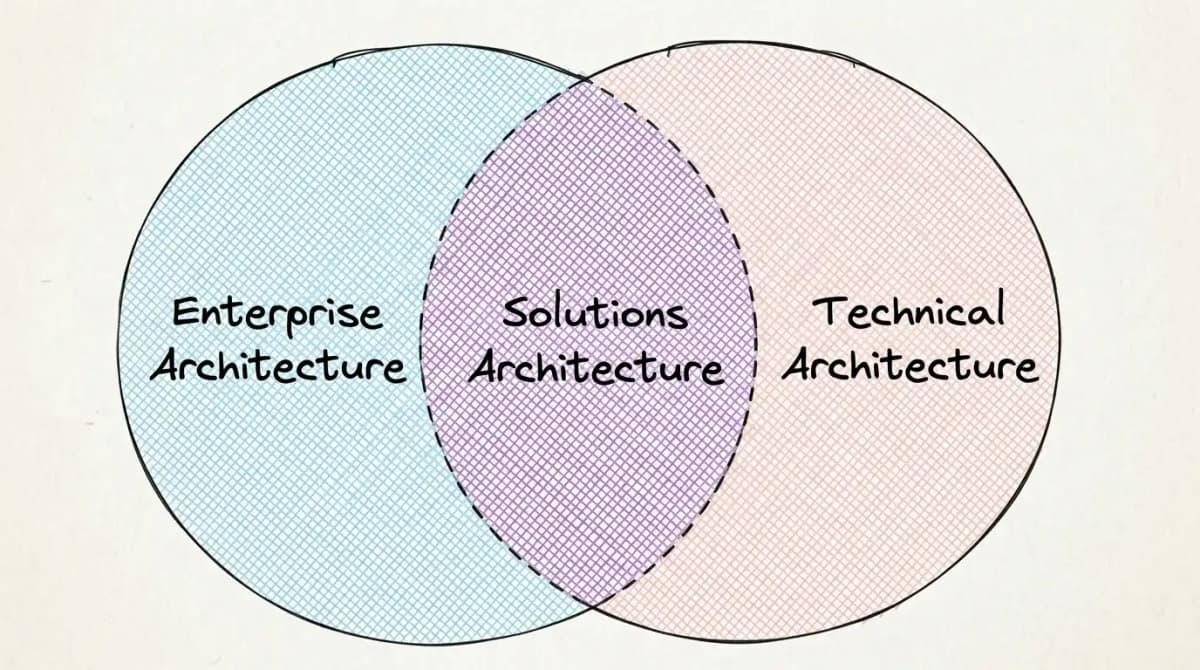
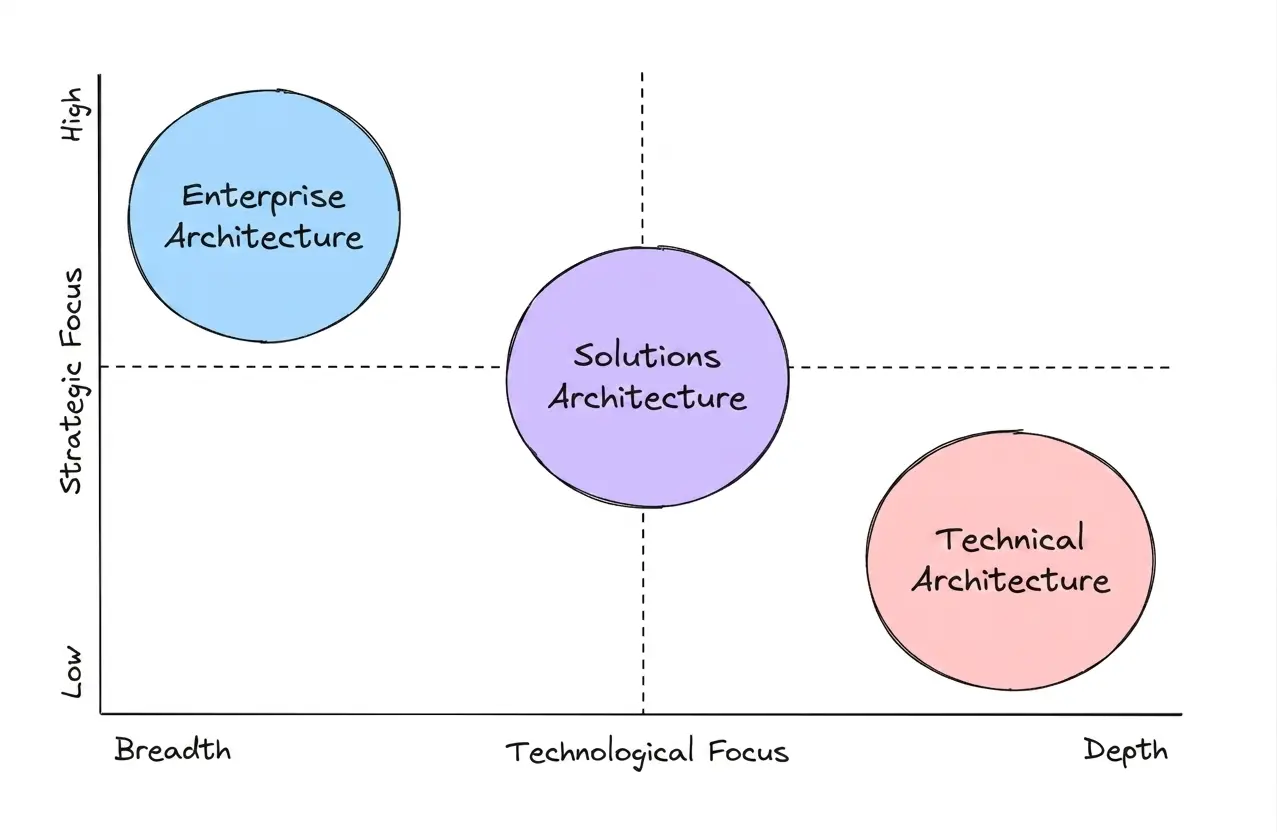
A simple way to understand this role is to look at what surrounds it. On one side, there is Enterprise Architecture, with a broader view of the organization, focused on direction, governance, and standardization. This is where references and usually come from, so each team does not end up following a completely different path.
On the other side, there is Technical Architecture, which sits closer to implementation. It goes deeper into technical decisions, system structure, and execution details.
Solutions Architecture sits right in the middle. It takes that broader direction and turns it into a viable solution within the company’s real context.
In more mature organizations, that relationship also works in reverse. This happens because enterprise-level guidelines help orient the solution, but real implementation reveals limitations, friction, and exceptions that do not appear with the same clarity at the more strategic level. That is why Solutions Architecture also feeds feedback back into Enterprise Architecture based on what emerges in practice.
Where It Separates from Software Architecture
This is one of the most common sources of confusion. The two are related, but they do not look at exactly the same kind of decision.
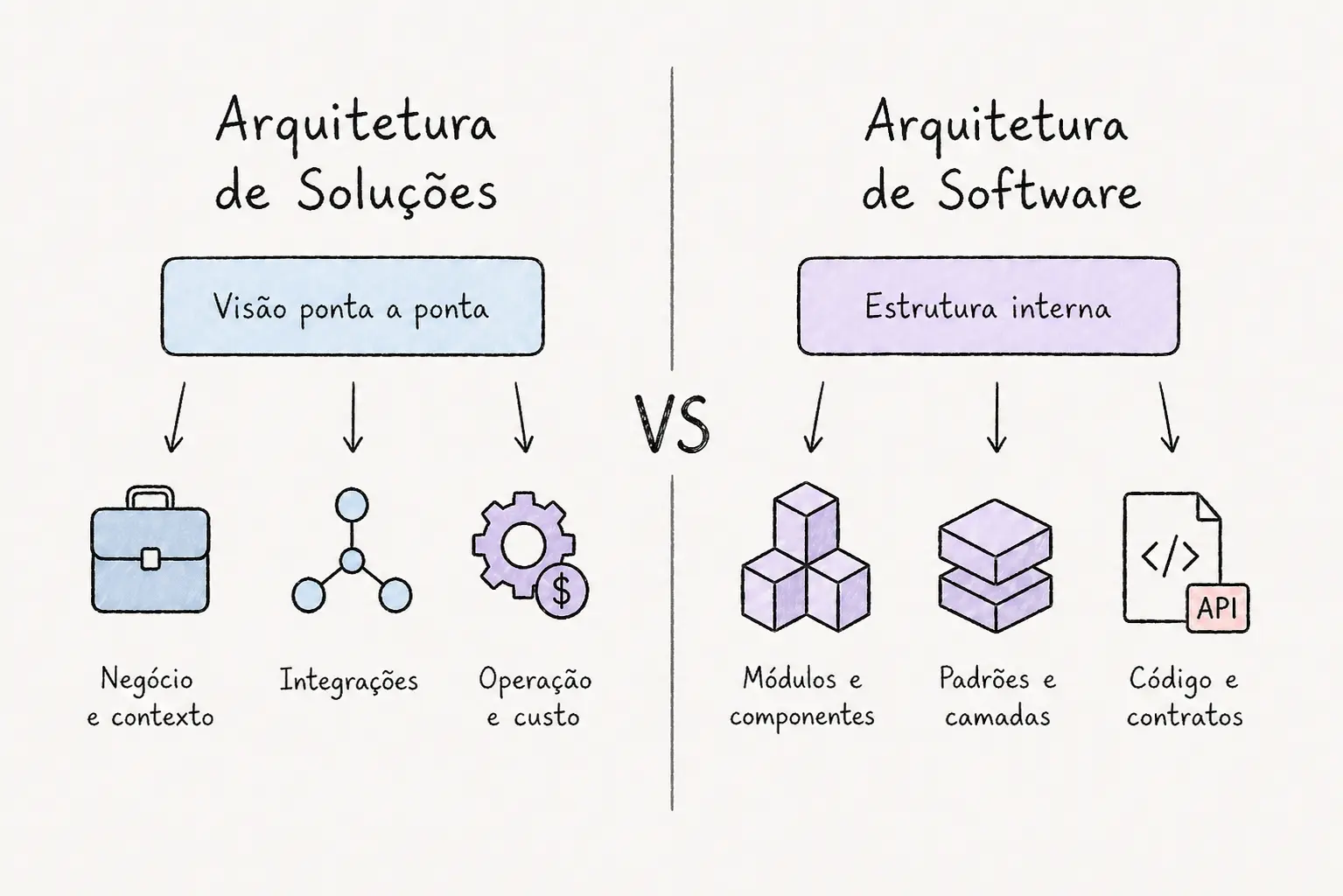
Solutions Architecture tends to look at the solution end-to-end: business context, integrations, constraints, operations, cost, security, scalability, and viability inside the company. The focus is making the solution work in the real ecosystem where it exists.
Software Architecture goes deeper into the internal structure of the system. It looks more closely at modules, components, responsibilities, architectural patterns, code organization, and the technical evolution of the application from the inside.
In many cases, Solutions Architecture takes part in decisions around stack, databases, messaging, storage, integrations, and infrastructure services — but at the solution level, thinking about viability, operations, cost, scale, and risk. Software Architecture, in turn, tends to go deeper into how those choices translate inside the system: internal organization, modules, responsibilities, patterns, contracts, coupling, and code evolution.
In practice, the two intersect all the time. The difference is less about opposition and more about focus level. Solutions Architecture tends to define the shape and contour of the solution better. Software Architecture tends to go deeper into how that system will be structured internally.
When This Role Becomes Explicit
The need for this role changes a lot depending on the company’s context.
In larger environments, with more systems, more integrations, more involved areas, and greater organizational impact, this responsibility tends to become clearer. The more complexity enters the picture, the more important it becomes to have someone looking at the solution end-to-end, connecting business constraints, technology, operations, and risk.
In smaller teams, that work still exists, but it does not always appear under the name Solutions Architecture. Instead of being formalized as a role, it is often distributed among tech leads, more experienced developers, and other technical leaders, usually in conversation with product, operations, and the impacted areas.
In many companies, this separation also does not appear in a pure form. The same professional may end up taking on both software architecture and solutions architecture responsibilities at the same time, especially in smaller or less specialized teams.
Conclusion
Solutions Architecture exists to provide technical direction for business problems within the company’s real context. It does not replace product, software architecture, or operations, but it connects those fronts when the solution requires an end-to-end view.
Understanding this role is the first step. The next one is seeing the real weight of the decisions it owns — and that is where Solutions Architecture stops looking like theory and starts showing practical impact.
Question1/5
Which definition best represents Solutions Architecture in the article?
Recommended
Resources related to solutions architecture and system design.