Solutions Architecture: what it really decides in production systems
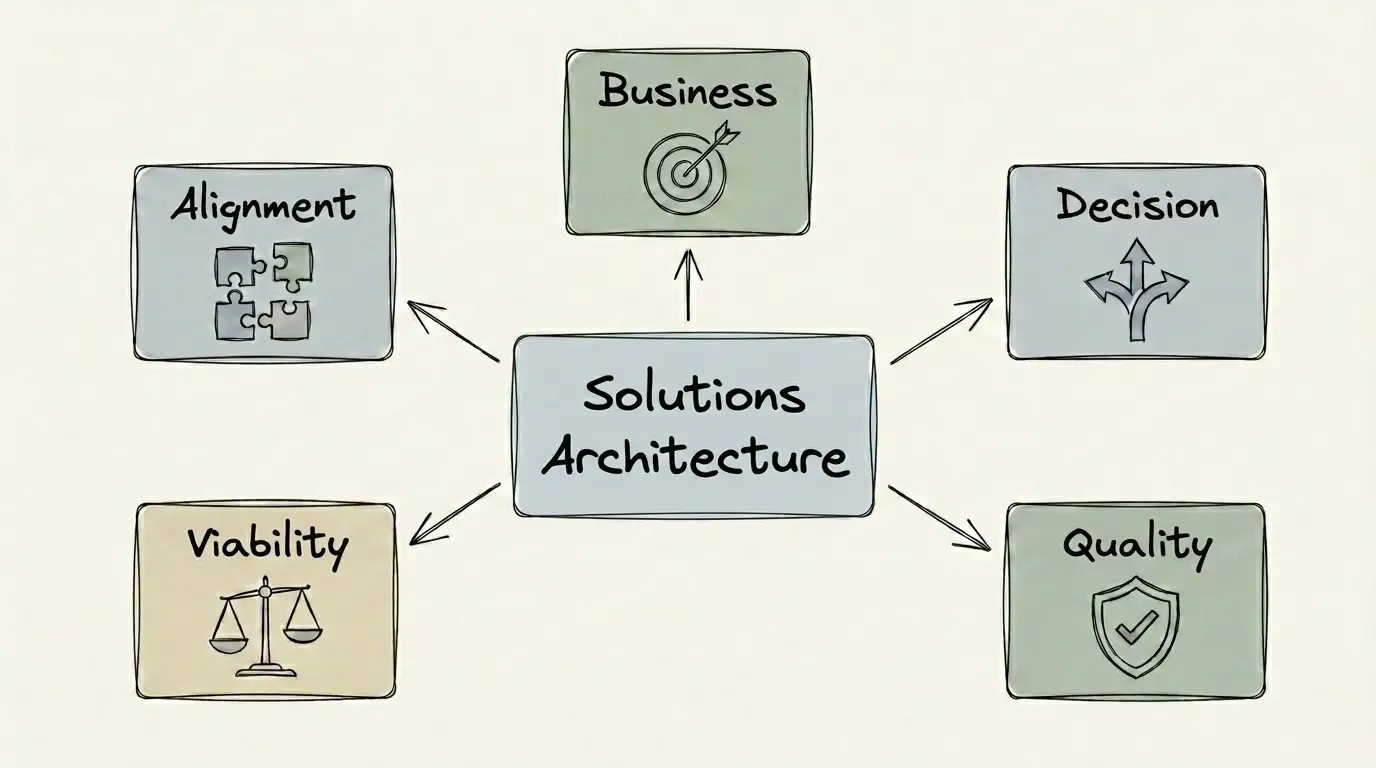
Solutions Architecture is not about drawing boxes and arrows. It is about turning business requirements into technical decisions that sustain integration, scalability, security, cost, and operations in the real world.
architecture
solutions architecture
software
systems design
architecture
Ednaldo Luiz
Level: Intermediate
Level:
Published:
Last updated:
Recommended
Resources related to solutions architecture and system design.
Software Engineer focused on architecture and performance. I work with Java/Spring Boot, well-structured SQL, scalable services on AWS, and GenAI solutions with RAG (LangChain + vector databases). I value readable code and well-justified decisions.
A lot of people treat Solutions Architecture as if it were just another name for drawing boxes and arrows. But that is not the point. The point is deciding how a business need turns into a solution that actually works in the real world, with choices around integration, data, security, performance, availability, cost, and operations.
The diagram shows up as an alignment artifact. It helps different areas see the solution, makes boundaries clearer, exposes critical integrations, and anticipates risks before implementation starts.
This matters because many systems do not struggle because they lack the latest framework or trendy cloud setup. They struggle because they lack direction. Without a well-thought-out solution architecture, teams pile on technology, couple integrations carelessly, and postpone difficult decisions. The bill comes later: rework, rising costs, fragile operations, and a system that becomes harder to evolve.
Solutions Architecture is the work of taking a business need and turning it into a technical response that makes sense within the company’s context.
It defines how functional and non-functional requirements will be met by a viable solution, considering integration, data, security, performance, availability, cost, and operations.
In many cases, that shows up as concrete non-functional requirements: response time (up to 200ms), load capacity (50,000 simultaneous requests), availability (99.95%), zero downtime during business hours, elasticity, and operational cost limits.
In practice, that conversation becomes decision-making: which capabilities matter most, which systems need to participate, which constraints weigh the most, and, above all, what is actually sustainable in terms of cost, operations, security, and evolution.
For many people, their first contact with this topic comes through the AWS Certified Solutions Architect – Associate (SAA-C03) certification. It gained traction precisely because it reinforces practical pillars of the discipline: security, resilience, performance, and cost.
Solutions Architecture exists to provide technical direction to a business problem.
Solutions Architecture often creates confusion because it touches multiple fronts at once: business, product, engineering, security, and operations. From the outside, it can look like it is trying to own everything. But the real point is its boundary of action.
That confusion does not happen only because many areas are involved in the solution, but also because they do not always speak the same language. In many companies, the same concept gets different names across product, operations, support, sales, or engineering. When that language is not aligned early, the solution starts crooked: the team thinks everyone is discussing the same thing, while each side is actually understanding something different.
To understand what this role does, it helps to start with what it does not do:
It does not replace Product: the architect does not decide alone what is worth building or which problem has priority for the business.
It does not replace Software Architecture: it does not, in isolation, dictate every code pattern or the internal structure of a microservice.
It does not replace security or operations specialists: those areas still own their respective disciplines and deep technical decisions.
The role of Solutions Architecture is to connect these fronts when the problem requires an end-to-end view. It helps bring coherence to the solution as a whole, making constraints visible and preventing each area from optimizing only its own slice of the problem — which usually leads to a final solution that is expensive, fragile, or hard to evolve.
That need for connection also exists because the organization directly shapes the solution that comes out of it. Teams, internal boundaries, responsibilities, and communication patterns tend to show up in the system design itself. When areas that barely talk to each other need to build something together, that friction tends to reappear in the architecture. Ignoring that usually produces a solution that looks good on paper and misaligned in practice.
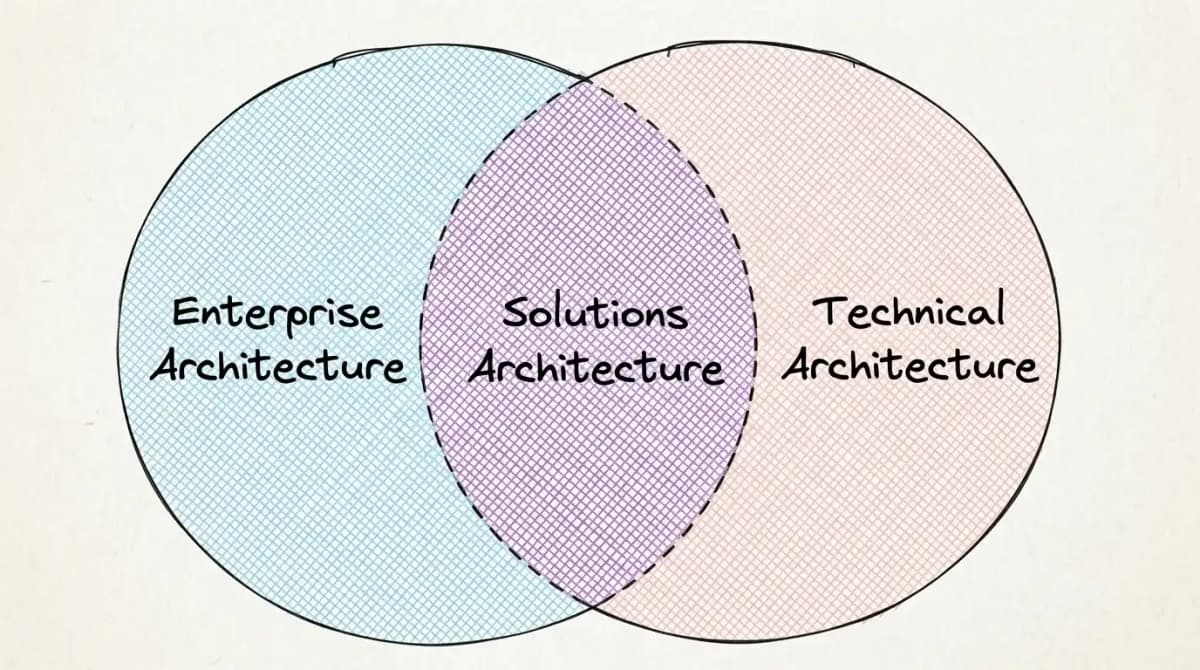
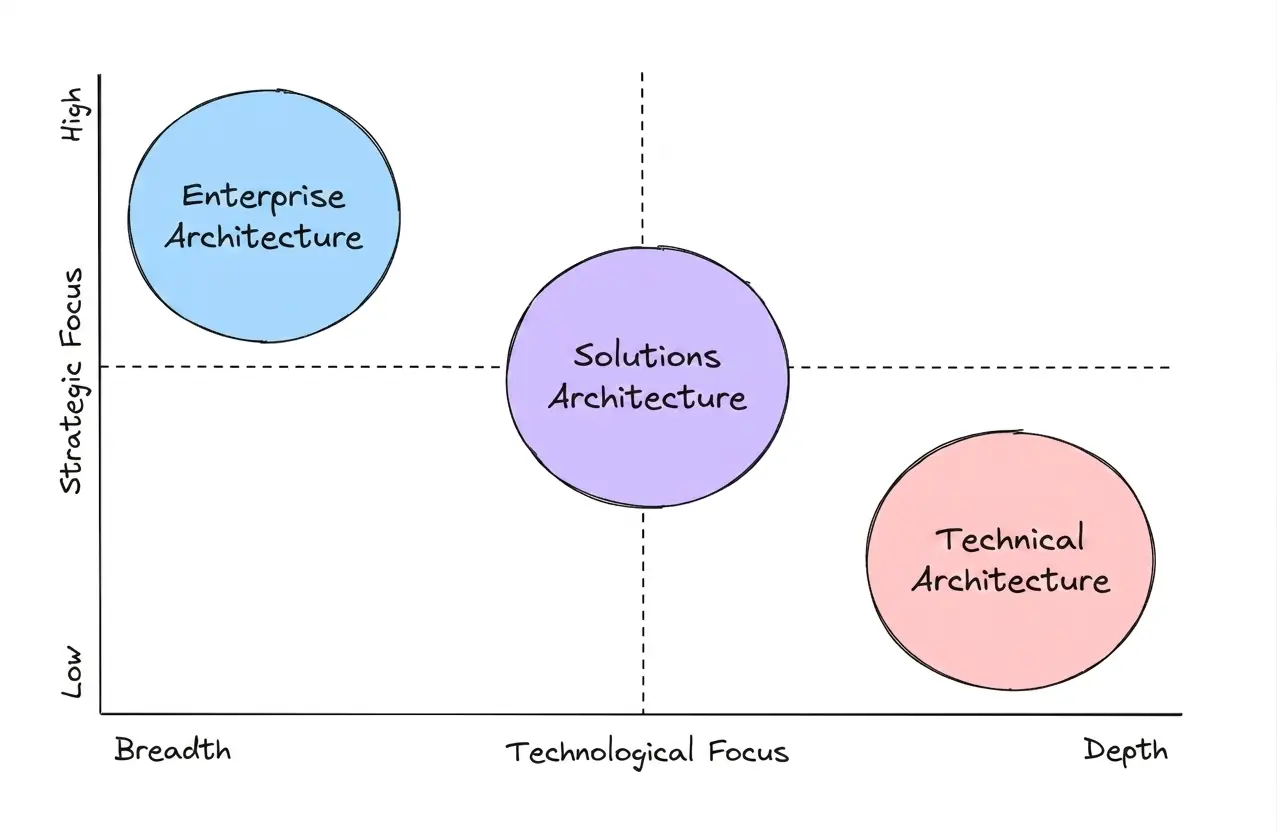
A simple way to position this role is to look at the space it occupies between two extremes. On one side is Enterprise Architecture, with a broader and more strategic focus on organizational direction, governance, and standardization. That direction often appears as architectural references and guardrails that guide specific solutions without forcing every team to reinvent the same decisions. On the other side is Technical Architecture, which goes deeper into implementation choices, internal system structure, and more detailed technical execution.
Solutions Architecture sits right in the middle of that path. It does not operate at the broadest Enterprise Architecture level, nor does it dive alone into the depth of Technical Architecture. Its role is to turn direction, constraints, and real needs into a viable solution within the company’s context.
In more mature organizations, that relationship also works in reverse: Solutions Architecture sends feedback back to Enterprise Architecture based on what shows up in real implementation.
This is one of the most common sources of confusion. The two are related, but they do not look at exactly the same kind of decision.
Solutions Architecture tends to look at the solution end-to-end: business context, integrations, constraints, operations, cost, security, scalability, and viability inside the company. The focus is making the solution work in the real ecosystem where it exists.
Software Architecture goes deeper into the internal structure of the system. It looks more closely at modules, components, responsibilities, architectural patterns, code organization, and the technical evolution of the application from the inside.
In practice, the two intersect all the time. The difference is less about opposition and more about focus level. Solutions Architecture tends to define the shape and contour of the solution better. Software Architecture tends to go deeper into how that system will be structured internally.
The need for this role changes a lot depending on the company’s context.
In larger environments, with more systems, more integrations, more involved areas, and greater organizational impact, this responsibility tends to become clearer. The more complexity enters the picture, the more important it becomes to have someone looking at the solution end-to-end, connecting business constraints, technology, operations, and risk.
In smaller teams, that work still exists, but it does not always appear under the name Solutions Architecture. Instead of being formalized as a role, it is often distributed among tech leads, more experienced developers, and other technical leaders, usually in conversation with product, operations, and the impacted areas.
In many companies, this separation also does not appear in a pure form. The same professional may end up taking on both software architecture and solutions architecture responsibilities at the same time, especially in smaller or less specialized teams.
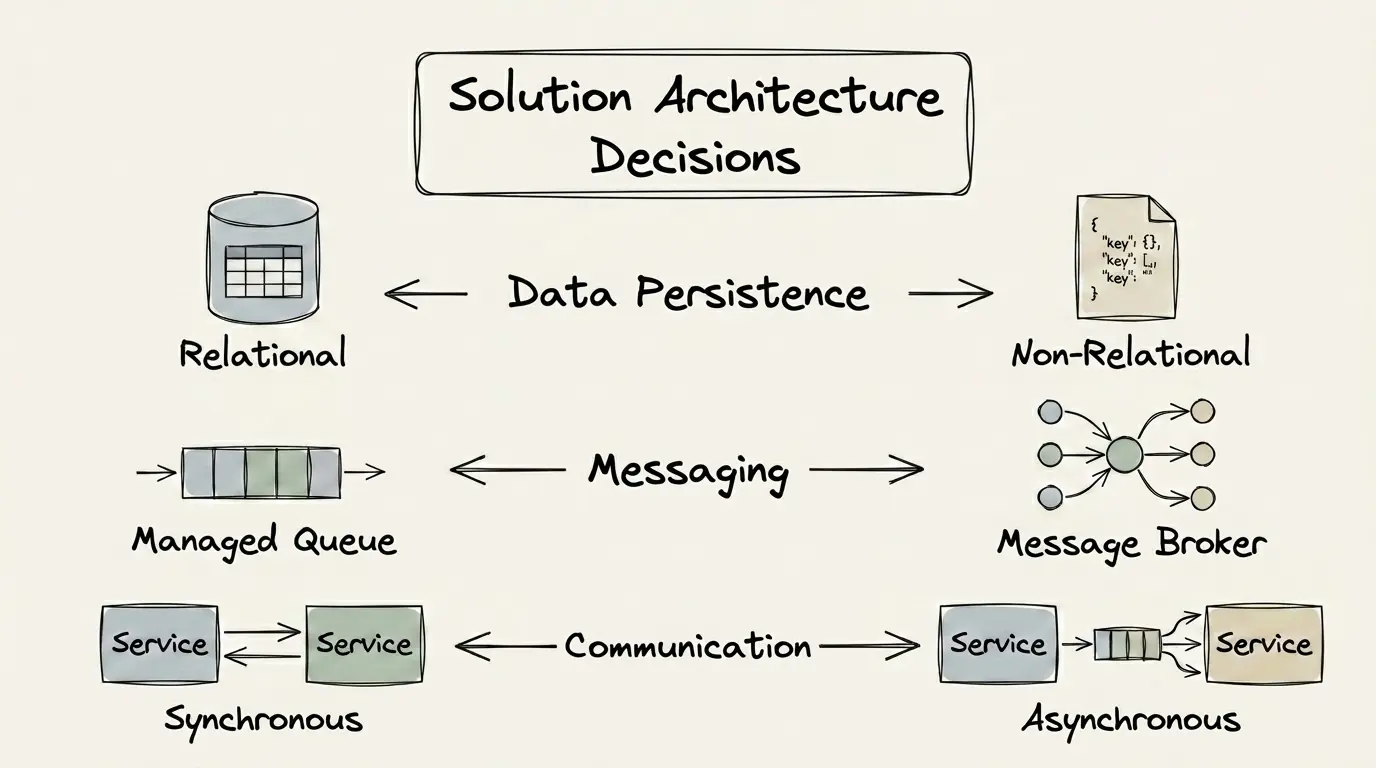
Solutions Architecture materializes in choices with long-term impact. It is not about “which technology is better,” but about which decision solves today’s problem without making tomorrow impossible.
To make that less abstract, it helps to look at a few common trade-offs. A system may be correct from a functional standpoint and still fail in the real world: a ticketing platform may register, reserve, and charge perfectly under normal conditions and still collapse when one million people try to buy at the same time.
The real question is not just “SQL or NoSQL,” but the context of the operation.
Go relational if: the domain requires strict transactional integrity, strong relationships between entities, and a more stable model over time. In that case, much of the consistency remains centralized in the database.
Go non-relational if: the core of the solution requires more flexible schemas, document-style aggregates, and rapid model evolution. Here, the flexibility usually comes with more application responsibility for consistency and validation.
Practical example: in a financial system or order flow involving payment, inventory, and invoicing, a relational database often makes more sense because consistency between those entities is critical, and guarantees matter a lot. In a product catalog with highly variable attributes per category, dynamic filters, and constant model evolution, a non-relational approach can reduce friction significantly.
Here the decision often revolves around operational friction vs. flexibility.
Go with a managed queue if: the team is small, the main problem is simple decoupling, and the priority is to reduce operational burden. In general, this works very well for asynchronous processing scenarios without adding another piece of infrastructure to maintain.
Go with a message broker if: the solution truly requires more sophisticated routing, finer-grained control over messaging behavior, or more advanced delivery patterns. The gain is real, but it usually comes with more operational cost.
Practical example: if a small team already runs on AWS and only needs to decouple order creation, email sending, and background processing, a managed queue often solves the problem with less cost and less effort. In that scenario, bringing in a more robust broker without a real need can mean buying complexity too early.
The question is not just “event or API.” It is the kind of guarantee the business needs in that flow.
Go synchronous if: the business needs immediate confirmation of the operation. It is simpler to understand and debug, but it creates temporal coupling: if the called system fails, the whole flow suffers.
Go asynchronous if: the solution needs more resilience and decoupling. The trade-off is accepting some level of and handling observability, traceability, and user experience more carefully.
Practical example: when closing an order involving payment and inventory reservation, synchronous communication often makes sense because the user needs an immediate answer. Actions like sending email, updating BI, triggering notifications, or integrating with peripheral systems usually fit much better asynchronously.
Not every architecture decision is about choosing technology. In many cases, the more important question is different: should you build this from scratch, buy a ready-made solution, or integrate something that already exists?
Go build if: that capability is part of the business differentiator, requires deeper control, or needs to evolve in a way that ready-made solutions are unlikely to support without too much friction.
Go buy or integrate if: the problem is already well solved by the market, is not part of the company’s core, and the cost of maintaining a custom solution does not pay off over time.
Practical example: authentication, CRM, billing, anti-fraud, or internal search often do not need to start as proprietary products. In many cases, integrating a mature solution delivers results faster and with less risk. On the other hand, a capability directly tied to the company’s competitive advantage may justify internal development, as long as there is enough maturity to sustain that decision afterward.
If you cannot explain what you gained, what you gave up, and how the decision will be operated, the choice is not mature yet.
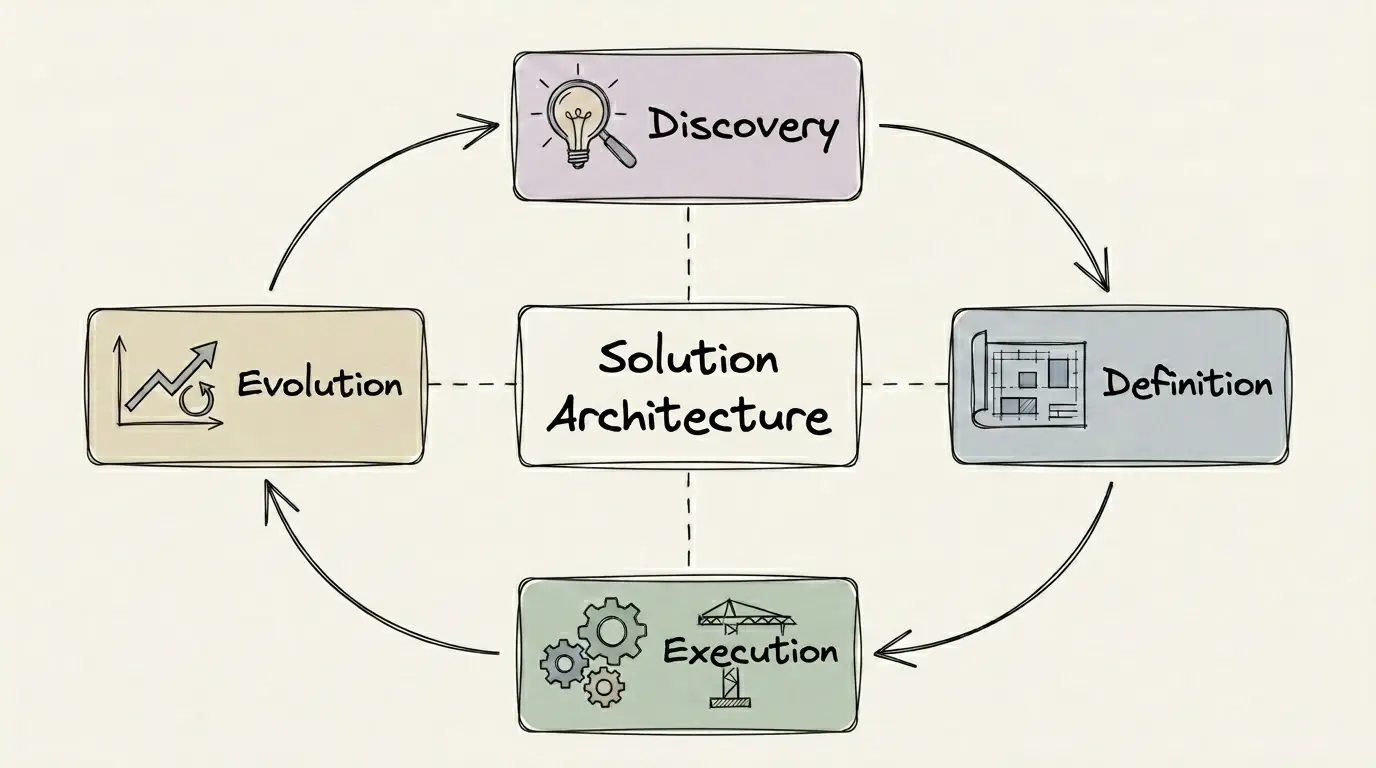
Solutions Architecture is not a gate you cross only once. It changes shape throughout the lifecycle, but it remains relevant from beginning to end. When it stays isolated only at the start, the solution is born disconnected from execution. When it appears only at the end, it is usually already too late to fix expensive decisions.
At the beginning, architecture helps validate whether the idea makes sense in the company’s real context. While product tries to understand value, priority, and problem, architecture steps in to assess technical viability, important constraints, critical integrations, initial cost, and the team’s ability to sustain the solution.
In some scenarios, that also includes capacity planning: understanding expected peaks, infrastructure limits, behavior under load, and the cost of sustaining that volume.
Before locking in more expensive decisions, it can also make sense to validate critical hypotheses with a , a targeted experiment, or a focused benchmark.
At this stage, the goal is not to detail everything. It is to avoid a good business idea depending on a solution that is unviable, too expensive, or incompatible with the company’s maturity.
After discovery, the solution starts taking shape. This is where architecture helps define boundaries, responsibilities, integrations, main flows, contracts, and the highest-impact technical choices.
The goal of this stage is not to produce diagrams for the sake of formality. It is to create enough clarity for the team to start building without ambiguity about how the solution is organized, where the data lives, and how the systems communicate.
Not every solution needs the same level of formalization. The higher the risk, criticality, and operational impact, the greater the need to register decisions, constraints, flows, and viewpoints.
Where this is usually recorded
In many contexts, this set of definitions appears in a SAD (Software Architecture Document), while more specific decisions are recorded in ADRs (Architecture Decision Records), design docs, or equivalent artifacts. The name may vary, but the logic is the same: make the main flows, constraints, integrations, risks, and decisions explicit enough to guide the solution.
During execution, architecture remains important because the original plan almost always meets real-world limitations. Legacy constraints, integration complexity, deadline pressure, and local team decisions can distort the solution along the way.
At this stage, architecture’s role is to sustain coherence. That includes reviewing important deviations, adjusting decisions, unblocking technical deadlocks, and preventing temporary shortcuts from becoming structural debt right afterward.
In more critical solutions, this work may also include transition planning, migration strategy, legacy dependencies, production rollout, and cutover concerns. In other words: it is not enough to know where the solution is going; you also need to know how it leaves the current state without breaking what already exists along the way.
Common mistake
Many solutions look good in the diagram and break during the transition. In more critical scenarios, rollout, migration, legacy dependencies, and rollback planning are not just operational details. They are part of the design.
Once the solution is in operation, architecture stays in the game. This is the moment when real cost, behavior under load, bottlenecks, incidents, and maintenance difficulty reveal whether the decisions actually made sense.
From that point on, Solutions Architecture helps evolve the solution based on evidence: what needs simplification, what needs to scale, what needs redesign, and what is no longer worth sustaining in its current form.
Whoever works in Solutions Architecture is not there just to draw a diagram and disappear. The real responsibility of this role is to give technical coherence to the solution as a whole, connecting business needs, company constraints, and execution viability.
In practice, that means leaving abstract discussion behind and turning business problems into technical choices. The business talks about growth, deadlines, risk, cost, integration, customer experience, and operational impact; architecture turns that into concrete choices about systems, boundaries, data, messaging, security, observability, and solution evolution.
This work also leaves concrete traces. Depending on the context, that may appear as design docs, integration flows, contracts, high-level diagrams, migration plans, and recorded decisions.
Another part of the role is making trade-offs explicit. In architecture, almost no choice comes without cost. People in this role need to show what is being prioritized, what is being sacrificed, and which risks are being accepted, so the solution does not look good only on slides.
Another central responsibility is taking care of the quality attributes that sustain the solution over time. It is not enough for the feature to work. The solution must be secure, operable, observable, resilient, and compatible with the level of scale the context demands.
Do not design the solution only for the ideal scenario, but also for operational reality, including observability and supportability.
In production, the system does not live only in the moments when everything works. It also needs to be supportable, recoverable, and observable when an integration fails, a service degrades, or an incident shows up under pressure.
Viability is also part of the equation. That includes thinking about build cost, operational cost, maintenance, and evolution. A good solution is not the most sophisticated one. It is the one that solves the problem without pushing forward a technical or financial bill the team and the company cannot sustain.
In the end, this role should not centralize everything. It exists to provide direction, define criteria, and create clear boundaries so the team can make good decisions without turning architecture into a bottleneck.
Solutions Architecture is rarely a purely technical role. People who do it well combine business repertoire, technical depth, contextual reading, and communication strong enough to align product, engineering, and operations.
More than knowing technology, this role requires understanding domain, real constraints, team maturity, and what the company can sustain in terms of cost and operations. It also calls for strong foundations in infrastructure, networks, data, service-to-service communication, and cloud, so decisions are made with a real sense of impact.
Solutions Architecture rarely deals with perfect choices. Most of the time, the work is about balancing real tensions between timeline, cost, risk, operations, performance, and the ability to evolve. That is why architecture is not about finding the best answer in the abstract, but about making the best possible decision within a specific context.
This is one of the most common trade-offs. In many projects, there is pressure to get something live fast. And sometimes that makes sense. The problem starts when speed becomes an excuse to ignore boundaries, fragile integrations, poor observability, and unresolved decisions that the team will carry for months or years.
Solutions Architecture needs to balance that all the time. It is not always worth designing everything in depth before starting, but it is also not possible to treat the solution as if what gets delivered now will not continue to exist later. Delivering fast may be correct. Delivering fast without direction usually becomes expensive.
Another common mistake is trying to prepare the solution for every possible future. That usually creates more complexity than value. Not every solution needs to be born ready for multiple channels, ten integrations, extreme scale scenarios, and rules that do not even exist yet.
At the same time, oversimplifying can also become a problem when the context already shows that certain changes are inevitable. The balance point is not to overengineer too early, but also not to pretend the solution will live in isolation. Good architecture does not try to predict everything. It tries to keep the solution simple without making it naive.
This trade-off appears all the time in infrastructure and platform decisions. Managed services usually reduce friction, speed up delivery, and remove operational weight from the team. In many scenarios, that is exactly what makes sense, especially when the team is small and product focus matters most.
On the other hand, using managed services can also mean less control over configuration, fine-grained behavior, portability, and even greater dependence on a specific vendor. In some cases, that is a great deal. In others, it becomes a limitation. The point is not to defend independence at any cost, but to understand whether buying simplicity now is worth the increased dependency later.
Some solutions look cheap to build but expensive to operate. Others require more upfront investment but reduce friction later. And sometimes a choice seems technically efficient while creating a recurring bill the company cannot sustain.
This trade-off is central in Solutions Architecture because many decisions that look good in the short term become problems in the medium term. It is not enough to ask how much it costs to get the solution running. It is necessary to ask how much it costs to maintain, observe, scale, fix, integrate, and evolve it. When that conversation never happens, the architecture is already starting wrong.
Every relevant choice charges something in return.
The role is not to eliminate trade-offs, because that is almost never possible. The role is to make those trade-offs visible early enough so the solution is not born with an embedded problem disguised as a technical decision.
Solutions Architecture exists to turn business needs into technical decisions that make sense in the company’s real context: integration, security, operations, cost, performance, and evolution.
The value of this work shows up in the consequences. When it is done well, the team gains clarity, avoids expensive mistakes, and evolves more safely. When it is ignored, the bill comes back as coupling, operational cost, incidents, and difficulty evolving.
Question1/5
According to the article, what best defines Solutions Architecture?